As French military strikes in Mali kill over 100 (on day one), and as the French fail in a hostage rescue attempt in Somalia, I post an aide memoire link on The French Military in Africa (Council on Foreign Relations)...
http://www.cfr.org/france/french-military-africa/p12578
Saturday, 12 January 2013

Monday, 7 January 2013
Review of The Edupunks' Guide to A DIY Credential
(review for Technology Enhanced Learning module)
The Edupunks’ Guide To a DIY Credential by Anya Kamanetz is the online resource I’ve chosen to evaluate for this blogpost. The guide is available to read online for free at…
The Edupunks’ Guide To a DIY Credential by Anya Kamanetz is the online resource I’ve chosen to evaluate for this blogpost. The guide is available to read online for free at…

Alternatively, it can be
downloaded as a pdf, if a $9 Day Pass is paid to scribd, or if you sign up for
a monthly ($9 per month) scribd membership - the business model for this
resource can therefore be described as ‘freemium’.
The Guide is just over 100
pages long and has been read on scribd 58,000 times.
What’s an Edupunk? Anya
Kamanetz explains…
An
edupunk is someone who doesn’t want to play by the old college rules. Maybe you
have interests that don’t fit the academic mold. Maybe you’re in a remote
location. Maybe you have a family, a job, or other responsibilities and you
can’t take on life as a full-time student. Maybe you love new technology and new
ways of learning. Or maybe you’re just a rebel! (page 2 para 2)
The thrust of the Edupunks’
Guide is excellent - encouraging people to take ownership of their own learning
and (for educators) framing the need to be open and flexible to student needs
(and to the needs of the ambient (societal, educational, media and industrial)
environments.
However, as educators we
know that undirected or self-directed learning can be as problematic and as
protracted as the ‘self-taught’ path which has always existed.
I pointed out some of the
dangers of a naïve approach to self-directed education in a blog response to an
interesting March 2012 BBC video article on ‘the internet sparking an
educational revolution’ (‘blackboards and textbooks are so old school’). In the
BBC video, Christina Cacioppo - a ‘School of Visual Arts,
Design co-teacher argued…
‘…students
don’t have to do things that they don’t want to do, and not just paper things
that they don’t need, things a traditional university would have them do…’ -
Christina Cacioppo - School of Visual Arts, Design co-teacher.
Whilst Adam
Pritzker - General Assembly Co-Founder swiped vaguely at the pointlessness and
cost of traditional educational models…
‘diy
education offers a wider array of potential experiences. You’re not committing
to paying a huge amount of money and to give a huge amount of time to a program
which, if you look at the statistics, may not have a definite outcome.’
In my March 2012 blog
response, I said that…
…these
people strike me as experienced media communicators and new-business people
behaving as amateur educators…
In her Edupunks’ Guide, Kamanetz
sagely anticipates our concerns as educators…
In
the case of DIY education, it means getting the knowledge you need at the time
you need it, with enough guidance so you don’t get lost, but without
unnecessary restrictions. DIY doesn’t mean that you do it all alone. It means
that the resources are in your hands and you’re driving the process. (page 3
para 5)
Kamanetz is also extremely pragmatic about the skills and
commitment required for the DIY or edupunk student…
Being
an edupunk is not for the faint of heart. Without exception, the students I
talked to said that being self-motivated and having good time management skills
are absolutely essential for success along a DIY educational path. I would add
that you need to be the type of person who’s willing to try something new, even
if it’s a little unproven and untested.
Much of Kamanetz’s guide
consists of clear and concise advice on creating a personal learning
environment – through the Edupunks’ DIY Education Manual. Kamanetz gives
excellent advice on how to create a Personal Learning Plan, on ‘How to Teach
Yourself Online’ (basic strategies for online research, inquiry and reflection),
on how to build a Personal Learning Network, on how (and why) to Find a Mentor,
on how and why to demonstrate (your) value to a network. Much of this section
of Kamanetz’s guide resembles conventional publications like Judith Bell’s (2010)
OU book ‘Doing Your Research Project’.
Page 55 (in The Finish Line
section) looks at colleges specialising in degree completion - suggesting
excellent, efficient and cost-effective routes to accreditation.
Empire State College (link
on page 56 (top para)) describes itself as…
…a college unlike any other. We believe that
people deserve the opportunity to study based on their personal and
professional goals. Rather than have a prescribed associate or bachelor's
curriculum, your degree program can be customized to focus on an area of study
necessary to achieve your objectives.
However many of the colleges
mentioned Western Governor’s University offer courses in relatively ‘hard’
disciplines (Nursing, IT, Business, Science), which can be easier to assess and
feedback through tests...
At WGU, you can earn your whole college degree by passing
tests. (page 59 (bottom para))
The guide does also look at ‘low-residency’ programmes, where learners can design personalised study programmes, guided and challenged by faculty advisors.
Goddard College’s (link on
page 62 (bottom para)) MFAIA Intro page says…
The Master of Fine Arts in Interdisciplinary Arts (MFAIA)
is a self-directed
learning community that fosters a climate of ethical, lifelong,
creative inquiry.
Each one of our students designs and pursues an
individualized course of study. Based on your unique personal interests,
intentions, and professional goals, faculty advisors - themselves accomplished
and evolving artists - work with you one-on-one, providing personalized
feedback, guidance, and challenge.
Despite the more flexible or
open student pathway, colleges are building pedagogical rigour into the
individualised course structures, using faculty advisors to provide ‘feedback,
guidance and challenge’.
Though the Open World
section of the Edupunks’ Guide (from page 67 onwards) is packed full of free
course and site links, the listings are concise and by no means exhaustive – MIT
OpenCourseware, Khan Academy and others are represented whilst MOOC’s and Coursera
aren’t mentioned at all? Almost all of the courses, colleges and universities
are (of course) in the U.S.. Other small irritants include an inference that the
OU (not specifically the OU’s OpenLearn component) is free…
On page 82 of the Guide, the
profile of the OU OpenLearn students is described by PhD researcher Kasia
Kozinska…
“Everybody
I have spoken to is a really, really keen learner,” she says. “They are very
strongly motivated, because there is no assessment. And they’re not necessarily
interested in formal feedback - they don’t want to do tests, they just want to
talk with others in discussion forums.”
While
some learners are more independent, captivated by the sheer intellectual
pleasure of learning, others are much more social, and interested in belonging
to a group, supporting and helping each other learn. A lot of students, of
course, are using OpenLearn to get more information before deciding to study
formally at the Open University, which is a great way to use open educational
resources.
So, programmes like
OpenLearn are still being framed as ‘informal’, an information-gathering gateway
to formal study at the OU?
On page 100 of her Guide, Kamanetz
concludes with rallying calls for DIY education…
After
reading through the resources in this guide, I hope you’ll agree that it’s
never been a better time to be a learner.
From
following a new interest, to finding and collaborating with peers and mentors, to
getting recognition for your work, there are new opportunities blossoming all
the time. I hope you’ll also get the message that there is no one recommended
path within DIY learning. If there’s any single change that I’d personally like
to make in the education world, it’s the realization that you, the learner, are
in charge.
You
should be able to decide what you need, and you should be given the resources to
accomplish it, as long as you’re willing to work hard and be a self-starter.
Once again, for all of its
faults and limitations, ‘The Edupunks’ Guide to A DIY Credential’ is an
excellent online resource.
Bibliography
Bell, J. (1999). Doing your research project: a guide for first-time
researchers in education and social science. 3rd Ed. Buckingham,
Open University Press.
Other
Resources
Coursera MOOCs
Today, for my sins, I've signed up for two short Coursera MOOCs - Massive Open Online Courses - Introduction to Digital Sound Design (Emory University) and E-Learning and Digital Cultures (University of Edinburgh). There's no point in continually going on about the potential of e-learning if I'm not prepared to engage in the medium (as a student and as a lecturer).

The courses don't start until the end of January - plenty of time to get my various affairs in order by then...
www.coursera.org

The courses don't start until the end of January - plenty of time to get my various affairs in order by then...
www.coursera.org
Friday, 4 January 2013
2 Anya Kamanetz URLs
I'm posting these Anya Kamanetz URLs here as an aide memoire, as part of my TEL Module research... Anya's DIY U website is one of the most garish I've ever seen, but full of nice resources and links...
http://diyubook.com/
http://www.fastcompany.com/user/anya-kamenetz
http://diyubook.com/
http://www.fastcompany.com/user/anya-kamenetz
The Edupunks' Guide To a DIY Credential
I'm going to read and review Anya Kamanetz's 'The Edupunks' Guide To a DIY Credential' for the next Technology Enhanced Learning submission, due date 11th January 2013?
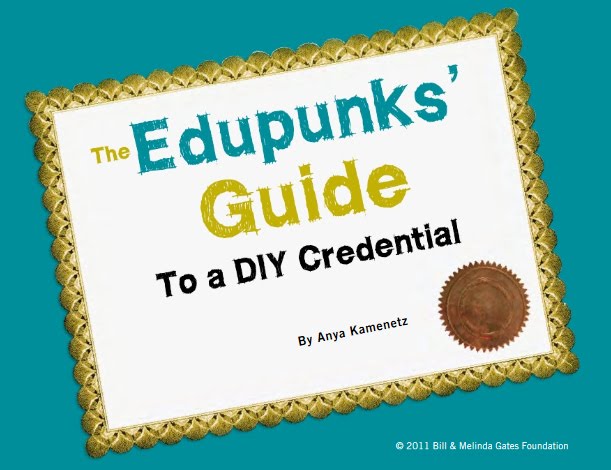
http://www.scribd.com/doc/60954896/EdupunksGuide
Feeling ill with a persistent cold. Everything's taking three times longer to muddle through. Next stop GP...
Thursday, 3 January 2013
Some Responses to OU's Innovating Pedagogy 2012
Submission as Part of Technology Enhanced Learning Module...
The OU Innovating Pedagogy 2012 Report can be downloaded from...
www.open.ac.uk/innovating
Briefly describe your selected item.
www.open.ac.uk/innovating
Briefly describe your selected item.
Innovating
Pedagogy 2012 is a 38 page OER pdf resource, incorporating a series of short
reports focusing on ‘ten innovations that are already in currency but have not
yet had a profound influence on education.’ This is the first of what is hoped
to be annual Innovation reports.
Why did you
choose it?
I read through many of the other supplied readings,
but was especially taken with the pointedly futuristic view of this report. It
takes as its model David Wood’s 1993
Report to the UK National Commission on Education, ‘A Day in School: 2015 AD’.
I like the idea that we can create a vision of how we’ll be Teaching and
Learning in 10 years time, or in 20 years time. This is a valuable and creative
exercise, which can help us to cut through many of the challenges we face
today, whilst having the confidence that our core educational goals are being
preserved and enhanced.
On page 7, Sharples
and his OU team set the tone for the report…
We explore current and emerging innovations in education for the 21st
century, in the hope that it will guide teachers and policy makers in making
informed decisions about curriculum design, course development and teaching
strategies. (page 7 (end
para))
What did it tell you that you already know?
Much of
what’s in the report, and indeed in the associated reading and resources is
already in place. The educational opportunities and potentials provided through
new technology and social networking are there, but they need to be grasped and
(crucially) they need to be shaped into true hybrid teaching and learning
environments.
The challenge is to create a hybrid system
that can offer simple or complex assistance, or perhaps a link to a human tutor
where needed, embedded into the structure and content of a study text. P. 9
(last para)
We are already
creating such hybrid systems – most of our course materials have been
distributed as pdfs (and similarly open digital formats) for years. If we treat
pdfs (and similarly open digital formats) as our OER (Open Educational
Resource) course source materials, we start with robust and transferrable
digital material. Pdfs and similar formats allow for multiple documents to be
open at once, on tablets or on pc screens. Pdfs can be annotated, bookmarked
and (I would suggest this is very important) text and images (including
diagrams and charts) can be stripped out of pdfs to be quoted (always with
correct attribution) in the students’ subsequent ‘manifestations’.
Wiki and blog
platforms (either within the VLE or on outside platforms) can allow learning
groups to collaboratively assimilate the gathered material and ‘manifest it’ (as
LIT’s Bernie Goldbach says) to the wider audience. Free platforms like Prezi
can achieve similar results. These existing platforms can already incorporate
(at least links to) more dynamic ‘mixed media’ such as video. They can already
make use of the collaborative potentials of social media (through comments
etc).
If we use these
platforms (blogs and wikis) within our existing VLE, the human tutor (as
described above) can (and should) be directly involved in our ‘hybrid learning
system’. Assessment (including data tracking and some analytics) is already
built into our VLE. We shouldn’t underestimate our requirement to act as
‘guides on the side’, providing the ‘simple or complex assistance’ which helps
our students’ learning (less teaching and more facilitating learning).
One further point
relates back to concept, environment and design. Though the designed
limitations of current e-book readers as described in the Report may be
overcome in future iterations, that doesn’t mean that they can’t already form part
of a current hybrid learning system. The same with mobile phones, handheld
devices, tablets, Twitter, Facebook, Youtube et al… all of these can already
form part of hybrid learning systems,
part of our students’ learning environments.
However, for me a
laptop currently remains the best device for the creation of an student educational environment, with
internet connection, a keyboard, soundcard, speakers and (crucially) a larger
screen (for synchronous collation of multiple documents and OERs). I currently
have three text documents, three pdfs, a word doc and six webpages open as I
construct this blogpost on one of my four laptops.
If we look
beyond the nitty-gritties of the current technology, we can see clear
potentials and objectives for the next few years. In her DIY U book, Anna
Kamanetz quotes Judy Baker at Foothill-De Anza…
The way I see it, higher education, ten, twenty
years from now is going to look very different. It won’t be the brick and
mortar and the semester and a course in this and a course in that. It’s going
to be more outcomes based and skill based, project based. You don’t have to
take these sixty courses or whatever it is to be a journalist. Someone will
identify your gaps and then you address the gaps, in what-ever way is possible.
And that may mean taking an online course from New Zealand, being in a
discussion forum with people in Canada, an internship in Mexico with Habitat
for Humanity. You just need to get the knowledge and skills whatever way you
can and then test out or present a portfolio. And when you add it all up, a few
years later, you actually are ready to be a good journalist. (p. 133 (para 2))
This is the
future of education for me – a seamless integration of (possibly interwoven and
matrixed) undergrad courses, part-timers at work in your industry and
conventional full-time students, postgrads, distance learners, special purpose
award students and lifelong learners all learning together.
The potential
for this model, the demand for this model already exists. The need for this
model exists amongst the learners, but our education system can afford to complacently
ignore that need because our system is comfortably fuelled by thriving CAO
numbers and government funding.
In her Aug
2011 blogpost ‘Humanities Grad School and its Discontents’, Anna Kamanetz
quotes William Pannapacker…
“In order to reform higher education, many of us
will have to leave it, perhaps temporarily, but with the conviction that the
fields of human activity and values we care about—history, literature, philosophy,
languages, religion, and the arts - will be more likely to flourish outside of
academe than in it. As more and more people are learning, universities do not
have a monopoly on the “life of the mind.”"
I think it’s
possible that many of us may have to move out of the conventional IoT sector in
order to pursue our Teaching and Learning potentials.
What did it
tell you that was new?
I’d never heard of latent semantic analysis…
Technology-enabled
feedback can include immediate automated responses to open assignments and
written student reports. The computational technique of latent semantic
analysis processes a corpus of text (such as previous student work over a range
of marks, or a set of model answers) to uncover similarities in meaning
between words and
phrases, then uses this to simulate human judgements of the coherence and style
of a new piece of student writing. (P. 13 (para 5))
The badges
idea was new to me. With its immediate association with the Boy Scouts, it
strikes me as highly appropriate for young children, but not for third level. I
thought the conceptualization behind this was fundamentally flawed and very
badly worked out. However, the idea has some merit. I was struck immediately
with its similarity to the military ribbons system – where achievements, merits,
long-service and awards can be discretely displayed within a simple coherent colour-coded
system.

Briefly
discuss a question or puzzle that you have in the light of your reading.
The Report
mentions disruption twice…
In compiling the report it became clear that the
innovations are not independent, but fit together into a new and disruptive form of education that
transcends boundaries between formal and informal settings, institutional and
self-directed learning, and nd traditional education providers and commercial organisations.
(p. 6 (para 3)) (my italics).
If education is ripe for
disruption, it may be
that the assessment of training and the offering of examination services at
higher levels of education will provide a route by which publishers can develop
credibility in the assessment and award of an ever wider range of qualification
products based around their content offerings. (p.12 (para 3)) (my italics).
I’m not
arguing against the fact that our current environment, fiscal, political,
sectoral, technological, social is undergoing (and will continue to undergo)
disruptive change. We are in a storm and we must cope with the storm in order
to survive and to thrive (through the success of our students). Coping with
disruptive change is what we do. In order to cope, we are agile, we attempt to
lead, we attempt to be ‘ahead of the curve’ if possible, but we do this whilst
preserving and enhancing our educational goals, knowing that therein lies the
success and full potential of our students.
But I question
whether ‘disruptive forms of education’ is
a concept I’d value? Neither do I believe that it’s useful to believe that all ‘education is ripe for disruption’. I
think we must be keenly aware that the OU operate largely within a UK
environment, and the UK’s education model (at every level) is in tatters.
Without being complacent, we need to recognize that we work in an Institute, in
an IoT sector in Ireland, where innovation, autonomy and problem solving are
valued (even if they’re not wholly supported always). Our environment is not
perfect, but that doesn’t mean we have to continually defer to a huge,
neighbouring and defective model.
We must face
the challenging and disruptive storm, whilst having the confidence that our
core educational goals are being preserved and enhanced.
I don’t
believe we are the storm? Disruption for its own sake will lead to many chaotic
and broken educational models, thousands of students who are unable to achieve
their full potential.
Kamanetz, A.,
(2010) DIY U Edupunks, Edupreneurs, and the Coming Transformation of Higher
Education. Chelsea Green Publishing. White River Jct., Vermont
Sharples, M. et al (2012). Innovating
Pedagogy 2012: Open University Innovation Report 1. Milton Keynes: The Open
University.
Friday, 16 November 2012
IADT 2012 Graduation!
Congrats to all our IADT Faculty of Film, Art & Creative Technologies graduates, but especially to our DL041 Animation cohort! It was great to see the entire group together once again. Special congrats to Kate, Cliona, Jack and Paul who won additional accolades and awards. Here's a picture of some of the lecturing team in our gowns...


Subscribe to:
Posts (Atom)